



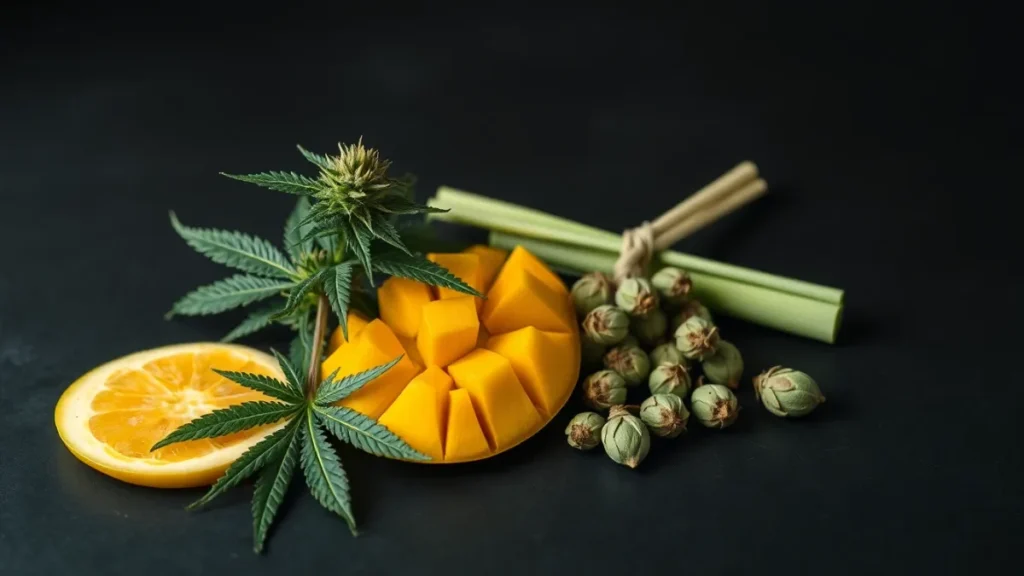
If you have ever heard that eating a mango before you smoke will turbocharge your high, you have already met myrcene without knowing its name. It is the terpene people credit for the heavy, sink-into-the-sofa feeling that some cannabis gives you, and it shows up in everything from hops to lemongrass to your fruit bowl.
It is also wrapped in more folklore than almost any other compound in cannabis. So let us separate what is real about myrcene terpene effects from what is just stoner legend that got repeated until it sounded like fact.
What is myrcene?
Myrcene (technically beta-myrcene) is a monoterpene, a small aromatic molecule that plants produce as part of their essential oils. In cannabis, it is frequently the single most abundant terpene by volume, which is a big part of why it gets so much attention.
It is not unique to cannabis, though. Myrcene is one of the most widely distributed terpenes in the plant world, and it pulls double duty as a flavour and fragrance ingredient in food and cosmetics. If you understand myrcene, you understand a chunk of how a lot of plants smell.
What does myrcene smell like?
Earthy, musky, herbal, with a faintly sweet, balsamic edge. Some people pick up notes of cloves, ripe fruit, or damp soil after rain. It is the backbone aroma in a lot of “dank” cannabis, the stuff that smells less like citrus and more like a forest floor.
In a blend it tends to round things out and add body rather than dominate with one sharp note, which is exactly why it is a workhorse in terpene formulations from Entour™ and other botanical blends.
Where is myrcene found?
You are probably eating and drinking myrcene more often than you realise. It turns up across the plant kingdom, often in plants we already associate with relaxation or strong herbal aromas.
- Hops, where it is a major component of the aroma and a big reason a fresh IPA smells the way it does.
- Lemongrass, long brewed as a calming tea in traditional medicine.
- Mango, the fruit at the centre of the famous high-boosting claim.
- Thyme, bay leaves and basil, common in the kitchen.
- Cannabis, where it frequently leads the terpene profile.
A review of myrcene’s properties notes that it occurs naturally “in the essential oils of plants such as hops, cannabis, lemongrass, verbena and bay, as well as in citrus fruits and citrus juices,” so its reach is genuinely broad. You can read more about how plants build these compounds in our guide to cannabis terpenes.
Myrcene’s reputation: relaxation, sedation and couch-lock
Ask around and most people will tell you myrcene is the “sleepy” terpene. It has a reputation for relaxation, muscle-loosening calm, and the infamous couch-lock, that pleasant but immobilising heaviness where standing up feels like a major life decision.
There is real signal behind that reputation, but the evidence is more nuanced than the marketing suggests. Most of it comes from animals, not people.
What the sedation research actually shows
In rodent studies, myrcene has produced clear sedative-type effects, but usually at high doses. One frequently cited finding is that a 200 mg/kg dose in rodents prolonged barbiturate-induced sleep time by roughly 2.6 times, which points to a genuine central calming effect at that level. The catch is that 200 mg/kg is an enormous dose relative to anything you would get from inhaling a flower.
The most honest summary comes from a 2021 review of myrcene’s potential health benefits, which states plainly that “no data is available that correlates the therapeutic use of pure beta-myrcene with health benefits in human participants,” and that most studies on myrcene were in animal models or cell culture. So when someone tells you myrcene “is sedating,” the accurate version is: it behaves like a sedative in animals, and humans report relaxation, but controlled human trials on pure myrcene are basically absent.
The science on myrcene’s effects
Sedation is only part of the story. Myrcene has been studied for pain, inflammation and muscle relaxation, and the preclinical results are genuinely interesting. Keep the word “preclinical” in mind, because almost all of this is animal and lab work.
Pain relief (analgesia)
Some of the earliest and most cited myrcene research is about pain. In one classic study, myrcene was identified as the compound that mimics the peripheral analgesic activity of lemongrass tea in rodents, and notably it did not cause tolerance on repeated dosing, unlike morphine-type drugs.
A separate study found that myrcene produced significant inhibition of nociception in mice at doses of 10 and 20 mg/kg, with the effect appearing to involve the body’s own opioid system rather than acting like an external opioid. For more on terpenes and pain specifically, our review of clinical studies on terpenes and pain goes deeper.
Anti-inflammatory and muscle-relaxant effects
A more recent rat study put myrcene to the test in adjuvant-induced arthritis. Local myrcene application reduced joint pain sensitivity and dampened inflammation, and crucially the effect was blocked by both CB1 and CB2 cannabinoid receptor antagonists. That is a direct mechanistic link between myrcene and the same receptor system THC and CBD work on, which is one of the more compelling pieces of evidence for terpene-cannabinoid synergy.
The same study was candid about its limits: chronic myrcene treatment did not prevent the underlying joint damage, and the authors flagged that human data remain thin. This is animal research pointing at a plausible mechanism, not proof of a treatment.
The honest caveat
Almost everything above is preclinical. Rodents, cell cultures, isolated tissues. That does not mean it is worthless, mechanisms found in animals often translate, but it does mean you should treat confident human health claims about myrcene with suspicion. If a product page promises myrcene will cure your insomnia or chronic pain, the science is not there yet. Our overview of terpenes and their effects applies the same honesty across the board.
The mango myth: does eating mango boost your high?
This is the big one. The claim goes like this: eat a ripe mango 45 to 60 minutes before consuming cannabis, and the myrcene in the fruit will help THC cross the blood-brain barrier, giving you a stronger, faster, longer high.
It is a lovely story. It is also, as far as the evidence goes, essentially a myth.
Where the idea came from
The theory has a real seed of plausibility, which is why it spread. Myrcene is found in both mango and cannabis, and there is a long-standing hypothesis that myrcene may help cannabinoids absorb across the blood-brain barrier. Combine that hypothesis with the fact that both contain the same terpene, and you can see how “mango makes you higher” became internet gospel.
Why it does not hold up
Two problems sink the mango theory.
- The dose is tiny. A mango contains very little myrcene compared with cannabis. The amount in a single piece of fruit is nowhere near the doses that produced effects in animal studies, where researchers used many milligrams per kilogram of body weight. You would need to eat an unrealistic mountain of mangoes to approach those levels.
- The mechanism is unproven in humans. The blood-brain barrier claim is a hypothesis from preclinical and theoretical work, not a demonstrated effect in people. The 2021 myrcene review is clear that human data on pure myrcene benefits simply do not exist.
So what are people actually experiencing when mango “works”? Most likely a combination of placebo, expectation, the natural sugar hit, and the simple fact that eating something on an empty stomach can change how you feel. None of that is the same as myrcene chemically amplifying THC. Enjoy the mango. Just do not expect it to do the heavy lifting.
Myrcene content in strains and the “0.5% means indica” claim
Here is another piece of widely repeated wisdom: if a strain’s myrcene content is above 0.5%, it is an indica, and below it, a sativa. It sounds precise enough to be true. It is not.
The indica versus sativa split has been losing scientific credibility for years. When researchers analysed the chemistry of commercial cannabis across the United States, they found that commercial labels do not consistently align with the actual chemical diversity of the plants. Samples labelled indica, sativa and hybrid were thoroughly intermingled when plotted by their real terpene and cannabinoid content, with myrcene, beta-caryophyllene and limonene sitting among the most abundant terpenes overall.
In other words, two jars labelled “indica” can have wildly different myrcene levels, and plenty of “sativa” labelled flower is myrcene-rich. The 0.5% rule is a tidy heuristic that the data does not support. What matters far more is the full chemovar, the combined cannabinoid and terpene profile, not a marketing category. If you want to chase the heavy, relaxed feel, look for lab-tested high-myrcene flower rather than trusting the indica sticker. Our roundup of terpene-rich strains is a better starting point than the label.
Practical takeaways
For consumers and for anyone formulating with terpenes, here is the grounded version.
- Read the lab results, not the category. If relaxation is your goal, find flower or products with verified high myrcene rather than relying on indica or sativa labels.
- Treat health claims as preliminary. The pain, inflammation and sleep evidence is promising but mostly preclinical. It is a reason to be interested, not a reason to self-medicate.
- Skip the mango ritual, or keep it for fun. It will not meaningfully boost your high, but a mango never hurt anyone.
- For formulators, myrcene is a base note. It adds earthy, musky body and pairs well with brighter terpenes. Pay attention to ratios, since myrcene shapes the overall character of a blend more than any single sharp top note.
- Dose and context matter. The same compound behaves very differently at culinary trace levels versus the high doses used in animal studies.
Myrcene is a genuinely important terpene with real, mechanistically plausible effects and a fascinating relationship with cannabinoids. It just happens to be surrounded by a couple of claims that sound scientific and are not. Knowing the difference is what separates an informed consumer from someone eating mangoes and hoping.
Frequently asked questions
Is myrcene safe to consume?
Myrcene is a common, naturally occurring flavour and aroma compound found in everyday foods like hops, mango and herbs, and it is used in the food and cosmetics industries. At the trace levels found in food and most terpene products it is generally considered safe, though as with anything, dose matters and very high concentrations are a different conversation. If you want a fuller picture, see our guide on limonene and other common terpene effects for how dosing and context apply across the board.
Does myrcene actually cause couch-lock?
High-myrcene cannabis is associated with heavier, more sedating, couch-lock style effects, and animal research shows myrcene has sedative properties at sufficient doses. But couch-lock is not down to myrcene alone, it reflects the whole cannabinoid and terpene profile working together, so myrcene is a strong contributor rather than the single cause.
How much myrcene is in a mango?
Very little compared with cannabis. The myrcene content of mango fruit is far too low to deliver the milligram-per-kilogram doses that produced effects in animal studies, which is the main reason the “eat a mango to boost your high” idea does not hold up.
Is high-myrcene always an indica?
No. Chemical analyses of commercial cannabis show that indica and sativa labels do not reliably match terpene chemistry, so myrcene levels above or below 0.5% do not dependably indicate one type or the other. Lab-tested terpene profiles tell you far more than the indica or sativa sticker.