




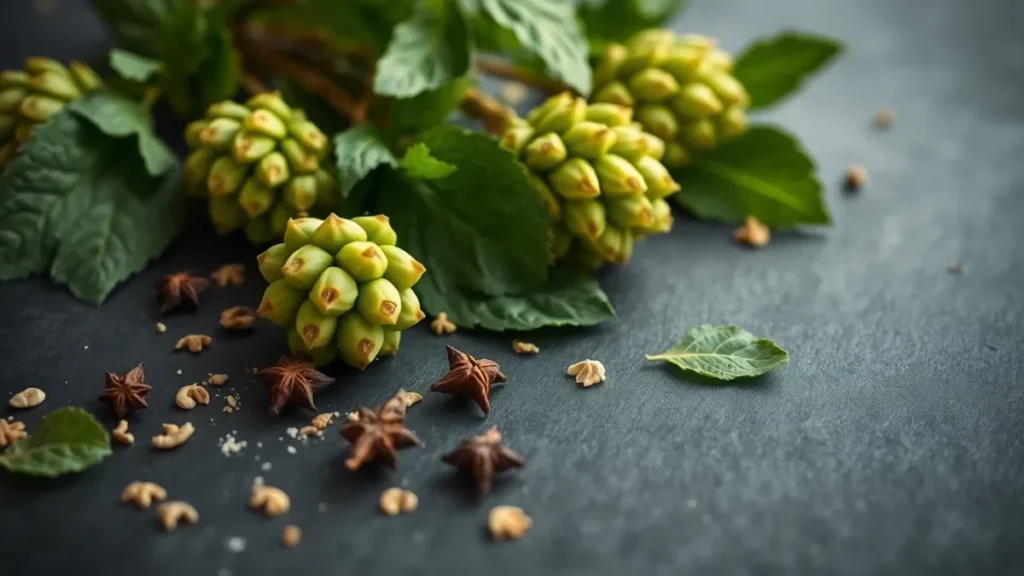
Crack open a fresh bag of hoppy beer ingredients, bruise a basil leaf, or open a jar of certain cannabis strains and you meet the same smell: earthy, woody, slightly bitter, a little like walking into a brewery. That shared note is mostly one molecule, and its name is a dead giveaway. Humulene takes its name from Humulus lupulus, the hop plant.
It is one of the more interesting terpenes to write about because the gap between what people claim about it and what has actually been studied is wide. So this is a guide to humulene terpene effects that tells you both halves: the genuinely promising lab science, and the popular claims that have run far ahead of the evidence. The appetite-suppressant story is the big one there, and we will get to it honestly.
What is humulene?
Humulene, also called alpha-humulene or alpha-caryophyllene, is a sesquiterpene. That just means it is built from three isoprene units instead of the two you find in lighter terpenes like limonene or pinene, giving it the molecular formula C15H24 and a heavier, less volatile character. You can see the basic chemistry on its PubChem entry (CID 5281520).
Being a sesquiterpene matters in practice. Heavier molecules evaporate more slowly, so humulene tends to stick around in an aroma profile and survive a bit more handling than the bright top notes do. If you want the wider context on how terpene size and structure shape what you smell and feel, our guide to terpenes and their effects is a good companion read.
What does humulene smell like?
Earthy. Woody. Hoppy. A touch spicy with a faint bitterness underneath. If you have ever smelled hops, you already know humulene, because that brewery note is largely it. People often describe it as the smell of beer before fermentation, or of damp forest floor and dried herbs.
It is not a loud, fruity terpene. It sits in the background and grounds a profile rather than jumping out at you, which is part of why it pairs so naturally with the peppery spice of beta-caryophyllene.
Where humulene is found
Humulene shows up across a lot of aromatic plants, usually in herbs and spices with that deeper, savoury edge. Common sources include:
- Hops (its namesake, and one of the richest sources)
- Cloves
- Sage and basil
- Ginseng
- Black pepper and coriander
- Cannabis, in many strains
One detail worth knowing: humulene almost never travels alone. It is chemically a close cousin of beta-caryophyllene, and the two are usually produced together in the same plants, often in roughly linked amounts. When you read a lab report and see humulene listed, you will very often see beta-caryophyllene right beside it.
What does the science say about humulene terpene effects?
Here is the honest framing before we get into specifics. Most humulene research is preclinical, meaning it was done in cells in a dish or in rodents, not in human clinical trials. That does not make it worthless. It makes it early. Promising signals in a mouse are a reason to keep studying something, not proof it will work the same way in a person taking a puff or a few drops. Keep that in mind throughout.
Anti-inflammatory effects (the strongest evidence)
This is where humulene has the most going for it. In a frequently cited 2007 study published in the European Journal of Pharmacology, researchers isolated alpha-humulene and trans-caryophyllene from Cordia verbenacea and tested them on inflammation in rats and mice. The compounds reduced paw swelling and cut the production of inflammatory signals like TNF-alpha and interleukin-1beta, with effects the authors described as comparable to dexamethasone, a powerful steroid used as the positive control.
That dexamethasone comparison is the line that gets quoted endlessly online, and for once it traces back to a real study. Just remember it was measured in rodents at controlled doses, not in humans.
A 2024 paper in Cell Biochemistry and Biophysics adds useful nuance. Testing alpha-humulene on human immune cells (LPS-stimulated THP-1 macrophages), the researchers found it cut IL-6 release by up to 60%, but, notably, did not reduce TNF-alpha or IL-1beta in that particular model. So the anti-inflammatory effect looks real but selective, not a blanket switch-off of every inflammatory pathway. That kind of detail rarely survives the trip to a dispensary blog.
Anti-allergic and airway effects
The same research group ran one of the more striking humulene experiments. In a 2009 study in the British Journal of Pharmacology, they induced asthma-like airway inflammation in mice and treated them with alpha-humulene, given either orally or as an inhaled aerosol. It markedly reduced eosinophil recruitment to the lungs, a hallmark of allergic airway inflammation, with dexamethasone again used as the reference drug.
Both preventive and therapeutic dosing worked, which is interesting because it suggests humulene might calm an inflammatory response already underway, not just block one before it starts. Again though: mice, aerosol or 50 mg/kg oral doses, not humans inhaling cannabis smoke.
Antibacterial signals
Humulene shows up regularly in essential oils studied for antimicrobial activity, and lab work suggests it can inhibit certain bacteria and disrupt biofilms. Broader research on aromatic plant oils backs the general principle that these sesquiterpene-rich extracts can inhibit pathogenic bacteria in vitro, though effects are strain-specific and depend heavily on concentration.
This is genuinely preliminary. “Kills bacteria in a petri dish at a measured concentration” is a long way from “works as an antibiotic in your body,” and nobody should treat humulene as an infection treatment.
Possible anticancer activity (very early)
A handful of preclinical studies have looked at alpha-humulene against cancer cells. In one line of work, researchers reported that humulene inhibited human liver cancer (hepatocellular carcinoma) cells and triggered apoptosis, partly by interfering with Akt signalling, with supporting data including a tumour-bearing mouse model published in Data in Brief.
Encouraging, but please read this correctly. These are cell and animal studies exploring mechanisms. There is no human evidence that humulene treats or prevents cancer, and presenting it as a cancer remedy would be irresponsible. It is a research lead, full stop.
The appetite-suppressant claim, fact-checked
If you have read anything about humulene online, you have read that it suppresses appetite. It is on dispensary menus, in countless blog posts, and repeated so often it sounds like settled fact. So let us be straight about it.
There is no solid human evidence that humulene suppresses appetite. No controlled clinical trials show people eating less because of humulene, at the doses found in cannabis or otherwise. The claim appears to have spread through repetition more than research, and it often gets paired with the assumption that because THC tends to increase appetite, a terpene with the opposite reputation must counteract it. That is a story, not a finding.
This matters because humulene is frequently the example people reach for when they argue terpenes can steer the effects of a strain. If the headline claim about it is mostly anecdotal, it is worth asking the same question about other confident terpene assertions. Our piece on whether higher terpene content means stronger effects digs into that habit of overstating what we know.
None of this means humulene does nothing to appetite in anyone, ever. It means the honest status is unproven in humans. If you see a confident percentage attached to humulene and weight loss, treat it with suspicion.
Humulene in cannabis and the beta-caryophyllene connection
In cannabis, humulene is a fairly common minor terpene, and it tends to appear in strains with earthy, woody, slightly herbal profiles rather than the citrusy or sweet ones. Because it travels with beta-caryophyllene so reliably, a high-humulene strain is usually also a notable caryophyllene strain.
That pairing is part of why humulene gets discussed in the context of the entourage effect, the idea that terpenes and cannabinoids work together rather than in isolation. Beta-caryophyllene is unusual because it can directly activate the body’s CB2 cannabinoid receptors, which gives it a clearer biological hook than most terpenes have. Humulene rides alongside it in the aroma but does not share that exact receptor trick, so be careful not to assume the two do the same thing in the body just because they smell related.
The broader truth about the entourage effect is that it is plausible and partly supported, but still not nailed down in rigorous human trials. If you want a grounded explainer, see our breakdown of how terpenes and cannabinoids differ and interact.
Practical takeaways
So what do you actually do with all this? A few honest, useable points:
- Use humulene as an aroma marker. If a strain or product smells earthy, woody, and hoppy, humulene is likely part of why. That is a reliable, real-world use of the knowledge.
- Trust the anti-inflammatory research the most, but hold it lightly. It is the best-supported area, yet it is still mostly animal and cell work. Promising, not proven in people.
- Ignore confident appetite claims. Until human studies exist, treat “humulene curbs appetite” as folklore, not pharmacology.
- Expect it alongside beta-caryophyllene. They come as a pair, so think of them together when reading a terpene report.
- Mind the dose gap. Studies use isolated compounds at controlled doses. The trace amount in a smoked or vaped product is a different situation entirely.
For formulators and product brands working with isolated or blended terpenes rather than whole-plant material, sourcing and consistency matter as much as the science, which is where well-characterised terpene formulations from Entour™ become relevant for building a reproducible aroma profile.
Frequently asked questions
Is humulene the same as caryophyllene?
Not quite. Alpha-humulene is sometimes called alpha-caryophyllene, and it is a close chemical relative of beta-caryophyllene, but they are distinct molecules with different shapes and somewhat different activity. They are usually produced together in the same plants, which is why people confuse them.
Does humulene really suppress appetite?
There is no good human evidence that it does. The claim is widely repeated online but is not backed by controlled clinical trials at realistic doses. Treat it as an unproven, anecdotal idea rather than an established effect.
What are humulene’s most science-backed effects?
Anti-inflammatory activity has the strongest support, including rodent studies where it performed comparably to the steroid dexamethasone and lung-inflammation work in mice. Antibacterial and anticancer signals exist too, but they are early-stage and limited to cells and animals.
Which plants contain the most humulene?
Hops are the classic high-humulene source, hence the name. It is also found in cloves, sage, basil, ginseng, black pepper, coriander, and many cannabis strains with earthy, woody aromas.
Humulene is a good reminder of how to read terpene information generally. There is real, interesting science here, mostly in the anti-inflammatory column, and there is a layer of confident folklore stacked on top of it. Knowing which is which makes you a far better reader of any cannabis or botanical label.