
Hemp is having a moment. After decades of being legally lumped together with its psychoactive cousin despite being fundamentally different in both chemistry and agricultural purpose, hemp was finally federally descheduled in the United States under the 2018 Farm Bill. That single piece of legislation opened the door for a surge of interest in hemp cultivation, including indoor growing for CBD, fiber, and seed production.
Growing a hemp plant indoors is not dramatically different from growing other cannabis varieties, but there are specific considerations around hemp’s legal definition, its growth characteristics, and the goals of indoor hemp cultivation that make it worth covering on its own terms. Whether you are a home enthusiast growing for personal CBD production or a small commercial operator exploring controlled indoor cultivation, here is what you need to know.
The Legal Landscape: What You Need to Know Before You Grow
Let me address the legal reality upfront because it genuinely matters and glossing over it would be irresponsible.
Under the 2018 Farm Bill (the Agriculture Improvement Act of 2018), hemp is defined federally as cannabis containing no more than 0.3% THC on a dry weight basis. Plants that exceed this threshold are legally classified as marijuana regardless of the grower’s intent, and the full weight of federal drug law applies. The USDA Agricultural Marketing Service administers the federal hemp program and provides the regulatory framework within which licensed hemp producers operate.
State-level regulations vary considerably. Most states have developed their own hemp programs in alignment with USDA requirements, but some have additional restrictions, different licensing thresholds, or specific requirements around testing and reporting. Before growing hemp indoors, verify the regulations in your specific state through your state’s department of agriculture. Growing hemp without appropriate licensing in a state that requires it exposes you to real legal risk, regardless of the plant’s THC content.
My personal view: the regulatory framework around hemp is still evolving and in places remains unnecessarily complicated for small producers. The 0.3% THC threshold in particular is not based on scientific evidence of psychoactivity risk but on a somewhat arbitrary figure from a 1976 report that was never intended as a legal standard. That said, the law is what it is, and compliance is not optional. Growing within the framework while engaging with the regulatory process to push for more sensible standards is the pragmatic path.
Why Grow Hemp Indoors?
Most commercial hemp cultivation is done outdoors or in greenhouses because the economics favor large-scale field production for fiber and seed. So why would anyone grow hemp indoors?
For CBD-focused production, indoor cultivation offers control over all environmental variables that influence cannabinoid and terpene expression. Indoor hemp grown for high-CBD flower can produce a premium product with consistent quality and profile that commands significantly higher prices than commodity field hemp. The craft CBD flower market, still developing but growing, rewards this kind of quality-focused indoor approach.
Year-round production is another factor. Outdoor hemp is a seasonal crop tied to photoperiod and climate. Indoor cultivation decouples production from seasons, enabling multiple harvests per year in facilities that would otherwise sit idle.
Genetic stability and phenotype selection also favor indoor cultivation. When developing or stabilizing hemp genetics for specific CBD profiles and terpene expressions, the controlled indoor environment provides the consistent conditions needed for meaningful phenotype comparison. This is particularly relevant to breeders and seed producers.
Selecting the Right Hemp Varieties for Indoor Growing
Not all hemp varieties are suited for indoor cultivation. Field hemp varieties selected for outdoor production tend to grow very tall (6 to 12 feet) and wide, which does not translate well to controlled indoor spaces. For indoor growing, you want varieties that have been specifically developed or selected for compact growth habit, high CBD content, low THC content (safely below the 0.3% limit with margin for error), and strong terpene expression.
Popular indoor-suitable hemp varieties include Elektra, Wife, Sour Space Candy, Lifter, and Special Sauce. These varieties are widely available from licensed hemp seed producers and carry consistent genetic profiles that have been tested and certified to meet federal THC requirements.
The THC compliance issue deserves special attention for indoor growers. Environmental stress, particularly light stress, temperature fluctuations, and late harvesting, can push THC content upward in any cannabis plant. Indoor growers have more control over these variables and can harvest at optimal timing, which helps maintain compliance. But it requires active management and regular testing as harvest approaches.
Setting Up Your Indoor Hemp Grow
Space Requirements
Hemp grown indoors for flower production is managed similarly to CBD cannabis. Plants are typically kept at 18 to 36 inches height through canopy management and appropriate vegetative time. A 4×4 foot grow tent accommodates 2 to 4 plants comfortably. A 4×8 tent handles 4 to 8 plants in a sea of green or SCROG setup.
Plan for approximately 1 square foot of canopy per plant in tightly managed setups, or 2 to 4 square feet per plant for fuller, bushier growth. Hemp, like other cannabis varieties, benefits from training techniques that distribute light exposure across the canopy and maximize productive bud sites.
Lighting
Hemp follows the same photoperiod response as other cannabis: it flowers when the light cycle shifts to 12 hours of light and 12 hours of darkness. During vegetative growth, maintain 18 to 20 hours of light per day to keep plants in vegetative mode and build structure before initiating flower.
For indoor hemp, modern LED grow lights are the standard of choice for most new setups. They run cooler than HPS, consume less electricity for equivalent light output, and typically have better spectrum control. The full-spectrum or broad-spectrum LEDs that cover both blue-heavy vegetative wavelengths and red-heavy flowering wavelengths in a single fixture are efficient and effective for hemp cultivation.
Light intensity matters significantly for cannabinoid production. Hemp grown under low light intensity (below 400 PPFD) will be spindly and produce less dense, less potent flower. For quality CBD hemp flower production indoors, target 600 to 900 PPFD at canopy level during vegetative growth and 900 to 1200 PPFD during flowering.
Climate Control
Hemp is a relatively robust plant but performs best within specific environmental parameters:
- Temperature: 68°F to 77°F (20°C to 25°C) during lights-on, not dropping below 60°F during lights-off
- Humidity: 50 to 70% during vegetative growth, 40 to 50% during flowering. Below 40% in late flower helps resin production; above 60% risks mold
- CO2: At ambient levels (400 ppm), hemp grows normally. Supplemental CO2 at 1000 to 1200 ppm under high light intensity can meaningfully increase growth rates and yields
Growing Medium
Hemp thrives in well-draining, slightly acidic to neutral soil with good organic matter content. The same soil considerations that apply to cannabis apply to hemp. A quality cannabis-specific soil mix amended with 20 to 30% perlite provides an excellent starting medium.
Hemp grows well in coco coir and hydroponic systems too. Coco coir in particular is popular for indoor hemp because of its excellent drainage and the control it gives over nutrient delivery. For more detail on growing medium selection, the same principles from our discussion of the best soil for growing cannabis indoors apply directly to hemp.
Growing Hemp Indoors: The Full Cycle
Germination (Days 1 to 7)
Start seeds in a moist germination medium: rockwool cubes, rapid rooters, or a simple seed-starting mix. Maintain 75 to 80°F and high humidity (80 to 90%) until taproot emergence, then transplant to the initial growing container. Keep lights at 18 to 20 hours per day and positioned far enough from seedlings to avoid light stress (typically 24 to 36 inches for LED panels).
Hemp seeds from certified producers typically show strong germination rates (80 to 95%). Seeds that do not germinate within 5 to 7 days under correct conditions are unlikely to be viable. If you are working with older or store-bought seeds and struggling with germination, there is an excellent guide on how to germinate old cannabis seeds that covers techniques for improving germination rates on difficult seeds.
Vegetative Stage (Weeks 2 to 6)
Under 18 to 20 hours of light, hemp builds its vegetative structure. This is when you establish plant architecture through training. Low-stress training (LST) involves bending and tying branches to create a flat, wide canopy rather than a single main stem. This exposes more bud sites to direct light and typically increases overall yield significantly.
Feed vegetative nutrients during this phase: higher nitrogen, moderate phosphorus and potassium. Maintain pH between 6.0 and 6.8 for soil, 5.8 to 6.2 for coco or hydro.
Watch for signs of sex during late vegetative growth. Hemp plants can be male or female, and males do not produce CBD-rich flower. If growing feminized seeds, this is less of a concern, but regular seeds require sexing and removal of males before pollen release. Pre-flower nodes typically appear at weeks 4 to 6 of vegetative growth.
Transition to Flower (Week 6 to 8)
Shift light cycle to 12/12 (12 hours light, 12 hours dark) to initiate flowering. Hemp plants typically show sex definitively within 1 to 2 weeks of light cycle change. Remove any males immediately. Begin transitioning nutrients toward a bloom formulation with lower nitrogen and higher phosphorus and potassium.
Flowering Stage (Weeks 8 to 16)
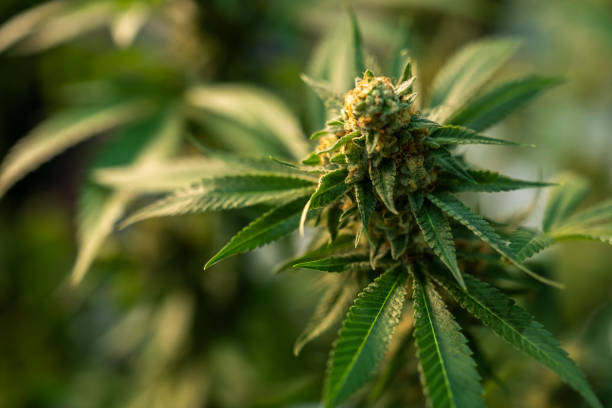
Hemp flower development follows the same progression as other cannabis varieties. Early flowering (weeks 1 to 4) sees rapid bud site development. Mid flowering (weeks 4 to 8) sees bulk development and resin accumulation. Late flowering (weeks 6 to 10 depending on variety) is when trichomes mature and cannabinoid content peaks.
Monitor THC content during late flowering with at-home testing strips or by sending samples to a certified laboratory. Indoor hemp producers are responsible for ensuring their plants stay below the 0.3% THC threshold. Testing at weeks 8, 10, and 12 of flowering gives you data to make informed harvest timing decisions.
The cannabis growth stages guide provides detailed information on trichome maturity assessment that applies directly to hemp harvest timing.
Harvest, Drying, and Curing
Harvest when trichomes are mostly milky white to amber for balanced CBD content with full terpene expression. Hemp flowers are dried and cured using the same methods as cannabis: slow drying in controlled humidity (45 to 55% RH) over 7 to 14 days, followed by glass jar curing with daily burping for 2 to 4 weeks.
Well-cured hemp flower has significantly better aroma, smoother smoke, and longer shelf life than improperly dried material. Do not rush this part. The same drying and curing principles that preserve terpenes in cannabis preserve them in hemp. For hemp grown specifically for its terpene profile and effects, proper post-harvest handling is as important as anything done during cultivation.
Common Challenges in Indoor Hemp Cultivation
- Hot testing (THC above 0.3%): Late harvesting, stress, and certain genetics push THC upward. Harvest on time and know your genetics.
- Mold in dense flower: Same prevention strategies as cannabis: humidity control, airflow, regular inspection.
- Male plants from regular seeds: Use feminized seeds from certified producers when possible. If using regular seeds, sex early and remove males before week 6 of flowering.
- Nutrient deficiencies: Hemp is susceptible to the same deficiencies as cannabis. Monitor closely and address early.
Final Thoughts
Growing hemp indoors for quality CBD flower production is genuinely rewarding work that sits at the intersection of skilled horticulture and an exciting, evolving market. The fundamentals are not mysterious: good genetics, controlled environment, proper nutrition, attentive management, and careful post-harvest handling. Get those right and indoor hemp will reward you with a product that stands apart from the commodity field hemp flooding the market.
Stay current with the regulatory landscape in your state and test your crop as harvest approaches. The compliance piece is non-negotiable, but it is manageable with proper planning. And frankly, the discipline of growing within a regulated framework while producing exceptional quality is part of what makes this crop interesting.